Dedicated to my dear friend Neill Duncan.

My new bass.
I was inspired by my wife's Maton EG 240 Supreme electric.
I am so impressed by its tonality and vintage look that I decided to
build an acoustic electric, hollow body, archtop, bass guitar to compliment her archtop acoustic electric, jazz guitar.

I put the word out to my luthier community asking if anyone
had an archtop guitar body laying around. My friend Lyndsay Marks
had an old 1950's Antoria body that had been kicking around
his workshop for 15 + years! It had no back, however, he also
had a spare, worm eaten, Hofner back that matched reasonably well.

This old Antoria 6 string was without a back or a neck.
The neck pocket was 10mm out of centre and the neck
block wood was of dubious quality. Poor quality, built in a hurry
by a dissatisfied East German.

There was no binding or purfling either.


Next I asked around if anyone had an old short scale bass neck.
Brett at Music Mayhem had an entire short scale bass with
its pickups removed. I bought it and removed the neck. This was
the only item that I needed for my project.

The machine heads came in handy too!

I was not satisfied with the peg head design so I cut it off.

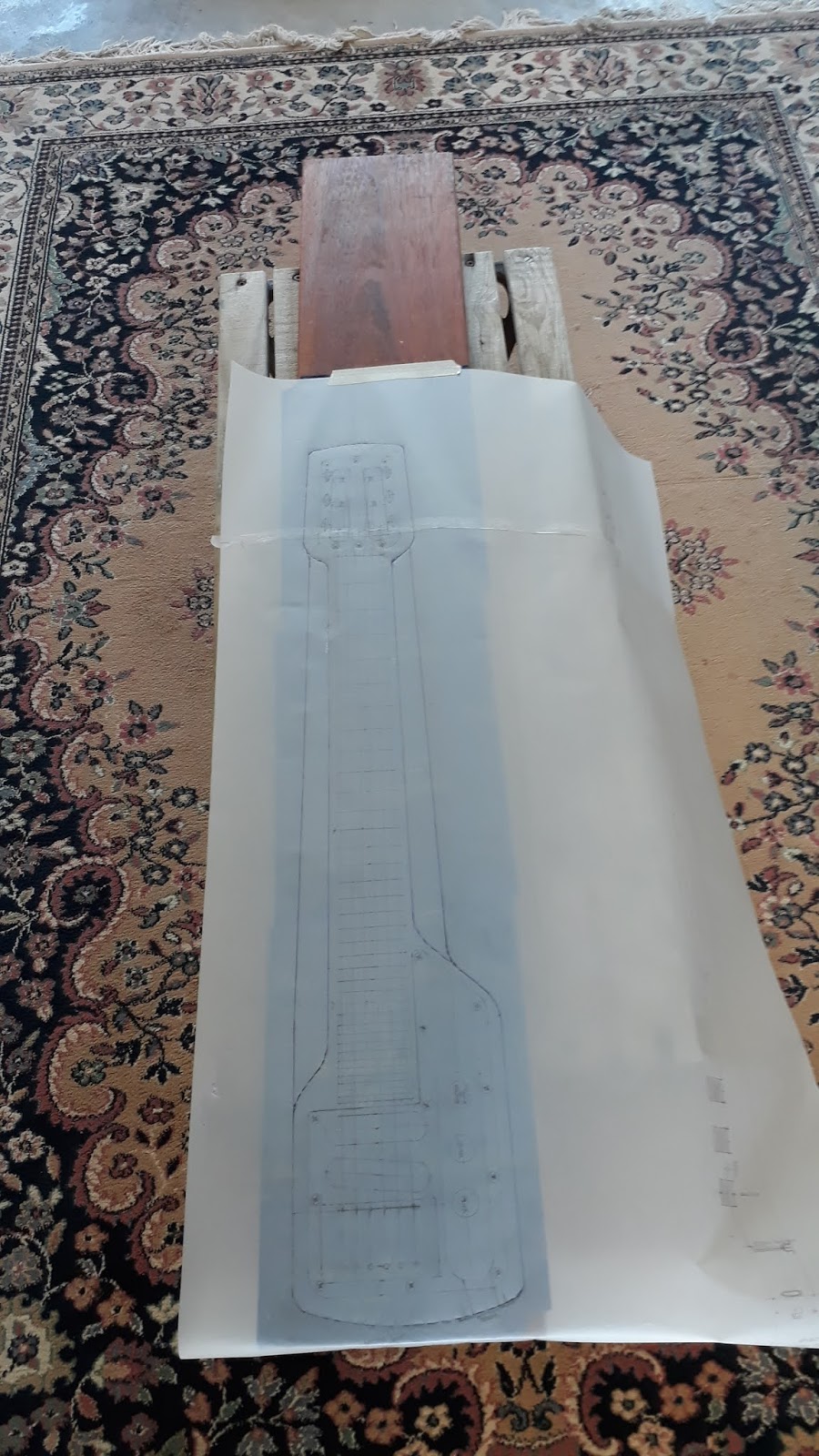
My next step was to make a full scale drawing.
This enabled me to make critical decisions about
the relative neck position, saddle and scale length.

Pickup selection and position was also important.
I ended up settling on a Seymour Duncan, Hot for P bass,
single coil, Telecaster bass pick up.

This is the pickup I chose. This is a relatively high gain pick-up.
It produces more defined high and low frequencies than the 1950's original
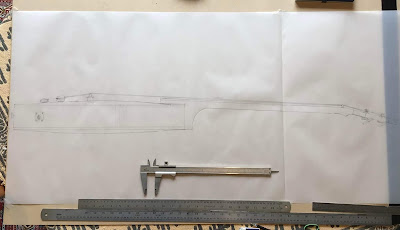
This side view gave me an opportunity to decide on the neck And string break angle angle over the saddle.

With the back off I was able to greatly reinforce the old Antoria,
laminated Maple top and sides. Some of the old body was delaminating.
I stabilised all the delaminated areas with superglue.
I also made and fitted a kerfing rim to allow me to glue the back onto the body.
The old tone bar, braces, were re-glued. I cut them short to accommodate the pick up cavity.
The new mahogany neck block replaced the old fir one.
The bracing around the neck block was reinforced and I made 2 hardwood
tone bar extensions to overlap the truncated tone bars to reinforce the sound board
in the area of the pick up cavity. I fabricated a copper pick up surround box
and fitted it snugly between the two hardwood tone bars.

Here the old laminated Maple Hofner back is glued on.

A view of the pick up cavity and the copper shield box,
mounted in the pick up cavity. The holes for the volume and tone
control have also been drilled

This is my new peg head design. The original maple one was
poorly conceived and I had my own ideas as to what would suit.
I cut and glued new wings out of sapele mahogany.
My keyhole in the top is derived from early Gibson and Maton
designs.

A detailed view of the new neck joint. The original neck was
a bolt on so I had to fabricate a neck block and dovetail to lock
into the the neck block in the body, a very complex joint.

A dry fit of the neck joint.


Neck glued in place.

This is my cut out of the stainless steel tail piece.
I scavenge items that suit my purpose.

The completed tail piece. The brass components are
ex rubbing strip, half round brass off the bottom of a boat.

The tobacco burst is applied.

Completed tobacco burst.

First coat of clear lacquer.


My new Peg head with burl mahogany veneer overlay
and my logo stencilled in gold.

First fit-out.
The silver and paua thistle broach made its way onto my tailpiece as a result of the fight for life that my musical brother, multi instrumentalist, Neill Duncan was fighting during the construction of this bass guitar. Sadly he lost that battle around Christmas time. Neill gifted me the broach when he left New Zealand for Australia 20 years ago.


I made the nut & saddle from and old ebony piano key.

New bass case. I had to locate a suitable case but could not find one.
I took to a jumbo archtop case and cut the neck to body section.
i made an extension and glued it into the area to extend the case to fit the
new guitar.


The final result. I love it!
The saddle is of ebony. I made the adjuster thumb wheels out of 5 cent pieces
which I drilled and tapped to fit 2 x 3mm metric thread studs set in the bridge.
The Pick-guard / pick-up ring is fabricated from a piece of ACM board,
an aluminium/plastic/aluminium sandwich board used by sign writers,
the edge produces a nice clean silver line when bevelled.
The volume and tone knobs are new old stock, vintage, bakelite and brass
radio knobs.
I've fitted DeAddario Black nylon, tape-wound strings

I have since fitted a new saddle. It is of a fixed height,
made from red Cedar and ebony. I hollowed out the saddle
to reduce its mass as much as possible.
The result is brilliant, better transfer of volume and tone!